Energy poverty is the lack of affordable, reliable, and clean energy, limiting people’s ability to live safely, study, work, and access essential services. Addressing it is critical to improving health, reducing inequality, and enabling sustainable development — especially for vulnerable communities. This page brings together key studies on energy poverty across India, creating a valuable repository that supports informed decision-making for policymakers, and practitioners working to advance equitable energy access.

In developing nations such as India, energy poverty is mainly driven by problems of access to certain energy sources and by low levels of electrification. Energy poverty here also takes the form of a lack of access to adequate facilities for cooking, lighting and electric appliances and to services such as space cooling and heating. Its main consequences are detrimental impacts on health, gender equality, education and economic development. Examples of energy poverty include a family in a rural area relying on firewood for cooking, a student in a rural area with no electricity struggling to study after dark, a person unable to pay their utility bill.

The factors contributing to energy poverty create vicious circles where poverty, inequality, and limited energy access reinforce each other. The causes of energy poverty include several interconnecting factors
Causes at the individual level
- Low income households struggle with poverty and poverty directly limits a household's ability to pay for energy services.
- Use of outdated power consuming appliances for lighting and heating/cooling systems.
- Use of polluting energy sources such as wood or coal for cooking, from force of habit rather than necessity
- Inefficient housing insulation, requiring more energy for heating and cooling, contributes to energy losses resulting in higher energy bills.
Causes related to the energy system
- The ever rising cost of fuel and electricity makes energy unaffordable for an increasing number of households.
- Lack of infrastructure (power grids, gas pipelines), especially in remote and rural areas, limiting access to modern energy.
- The high electrical losses incurred in transmission and distribution networks (T&D loss) due to inefficient and outdated equipment result in increased electricity tariff which indirectly causes energy poverty.
- In urban areas, unstable and unreliable power supply with frequent power fluctuations and outages cause disruption in energy services which is damaging for household consumers and for people who run small businesses.
Larger causal factors
- Inflation, and increasing costs of living which increase social inequalities and reduce people’s ability to afford clean energy.
- Economies that rely heavily on fossil fuels are vulnerable to price volatility and energy insecurity.
- Geopolitical conflicts can cause instability and disrupt energy supplies driving up prices.
- To further worsen matters, due to climate change, extreme weather events can damage energy infrastructure and increase the requirement for heating and cooling, further straining resources.

Consequences of burning solid fuels
Major health impacts
- Burning solid fuels for cooking and heating leads to air pollution which causes respiratory diseases, accidents and deaths annually, particularly among women and children.
Women are particularly at risk
- Women and girls often bear the brunt of fuel collection, which limits their time and opportunities to perform other tasks.
- Women are generally responsible for cooking meals, which exposes them to indoor air pollution, ultimately leading to respiratory diseases.
Environmental impact
- Further, reliance on solid fuel which is generally wood, contributes to deforestation and land degradation and burning them contributes to greenhouse gas emissions.
Consequences of unaffordability of energy
Unaffordability can cause health problems
- Stress, anxiety, and depression can arise from the inability to afford basic energy needs and maintain a comfortable living environment.
- Unaffordability of energy often results in people limiting their consumption of other necessities such as food or health services, resulting in various health problems.
- Inability to afford adequate heating or cooling leads to thermal discomfort which disrupts sleep patterns and can cause fatigue, weakened immune function, increased risk of cardiovascular problems, and impaired cognitive performance.
Consequences of insufficient lighting
- In remote areas, the lack of electricity limits study time, preventing children from studying after dark.
- Lack of proper lighting also increases the risk of accidents and crime.
Other effects of unaffordability
Households unable to pay their electricity bills might be disconnected by their energy supplier, resulting in an inability to use electricity and its replacement by other, potentially dangerous energy sources.
Households spending a large portion of their income on energy hinders their ability to escape poverty.

Tackling energy poverty requires a context-sensitive approach and recognizing that solutions must be tailored to the social, economic, and infrastructural conditions of each region.
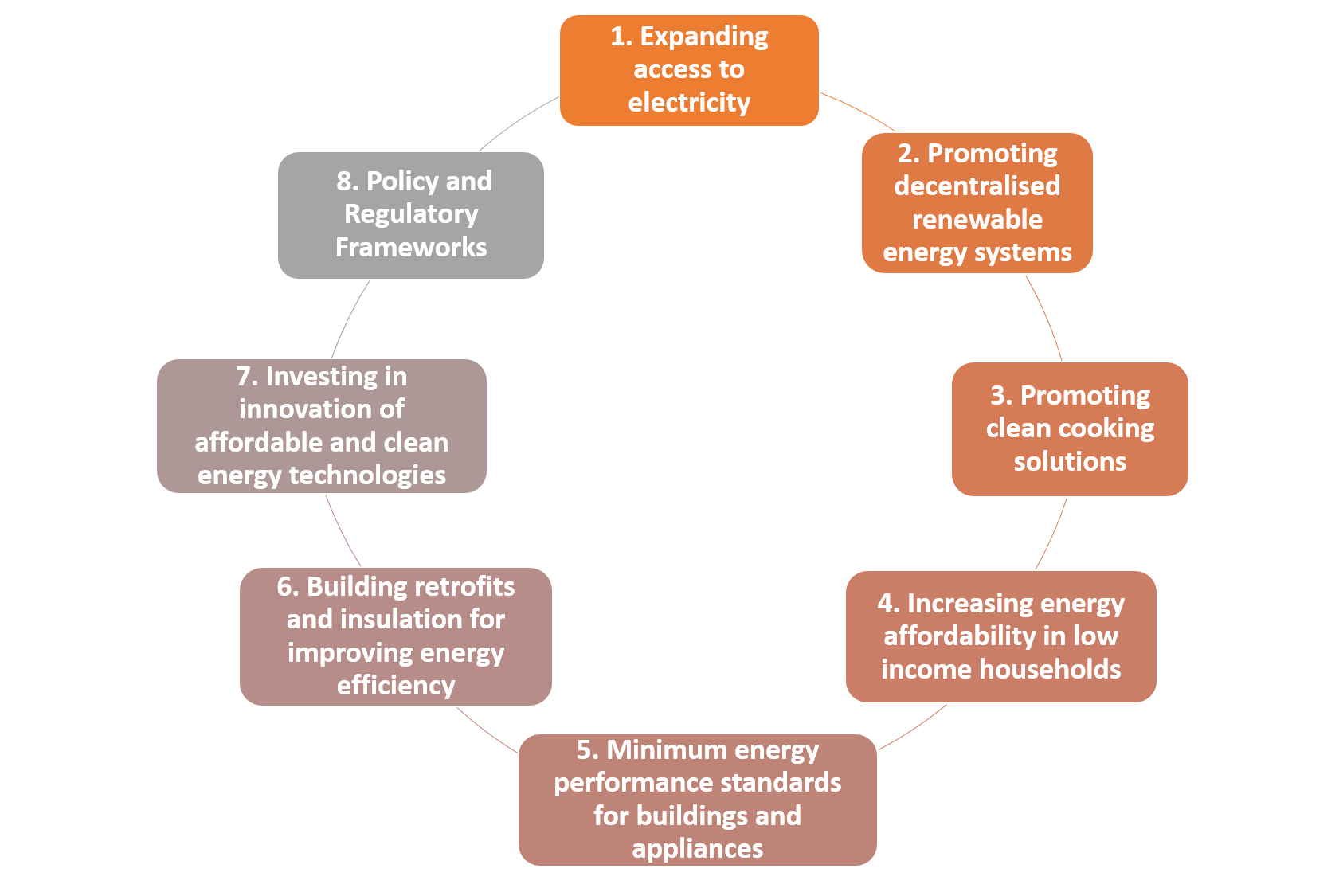
1. Expanding access to electricity networks
- Invest in and expand electricity grids, especially to reach rural and remote areas.
2. Promoting decentralised renewable energy systems
- Promote off-grid solutions like solar home systems, mini-grids powered by renewables, and clean cooking technologies for areas where grid access is challenging.
3. Promoting clean cooking solutions
- Facilitate the adoption of clean cooking fuels such as LPG, biogas, electric stoves and improved cooking stoves to replace the use of harmful solid fuels.
4. Increasing energy affordability in low income households
- Implement targeted subsidies
- Social tariffs
- Direct financial support to help low-income households pay their energy bills.
5. Minimum energy performance standards for buildings and appliances
- Implement and enforce standards for energy-efficient appliances
- Implement minimum energy performance standards for buildings.
6. Building retrofits and insulation for improving energy efficiency
- Develop programs that help low-income households improve the energy efficiency of their homes through insulation of roofs and walls, and efficient windows and doors.
- Develop cooling/heating solutions at the individual or collective level to facilitate access to cooling/heating. This is particularly important to prevent overheating or overcooling of homes in a changing climate.
7. Investing in innovation of affordable and clean energy technologies
- Support innovation in affordable and clean energy tehnologies suitable for off-grid and low-income settings.
8. Policy and Regulatory Frameworks
- Develop comprehensive national strategies with clear targets and indicators for reducing energy poverty.

Categories for article
Measurement & Indicators of Energy Poverty
Articles focusing on metrics, indices, multidimensional analysis, interstate or regional comparisons.
1. Understanding the variability of residential energy poverty in India
2. Household Energy Poverty Index for India: An analysis of inter-state differences
3. Measuring energy poverty: Focusing on what matters
4. Multidimensional energy poverty and human capital development: Empirical evidence from India
11. Spatial vulnerability of energy poverty among the households in Odisha
Social, Gender & Distributional Dimensions
Articles focusing on inequality, human development, gender, marginalized groups.
1. Reducing energy poverty: How to empower women and switch to clean fuel in India?
3. Energy poverty among urban street vendors in India: Evidence from Patna, Bihar
5. Socio-economic determinants of energy poverty amongst Indian households: A case study of Mumbai
Technology Adoption & Renewable Energy Solutions
Articles on solar adoption, off-grid systems, community energy, consumer behaviour, techno-economic pathways.
6. Energy poverty: A special focus on energy poverty in India and renewable energy technologies
Policy, Governance & Private Sector Engagement
Articles focusing on institutions, private sector role, governance, systemic issues.
Economic Development, Human Capital & Macro Linkages
Articles explicitly linking energy poverty with broader development outcomes.
1. Energy poverty and economic development: Household-level evidence from India
2. Multidimensional energy poverty and human capital development: Empirical evidence from India