Citizen consumer and civic Action Group (CAG) organized a rooftop solar PV awareness meeting at Abbotsbury Apartments, Alwarpet, Chennai, on Saturday, 18 July 2026. The programme was conducted as a small-group interactive discussion with members of the apartment association to create awareness about rooftop solar PV systems and address their specific concerns regarding adoption in apartments. The session was held from 5:00 pm to 6:30 pm.
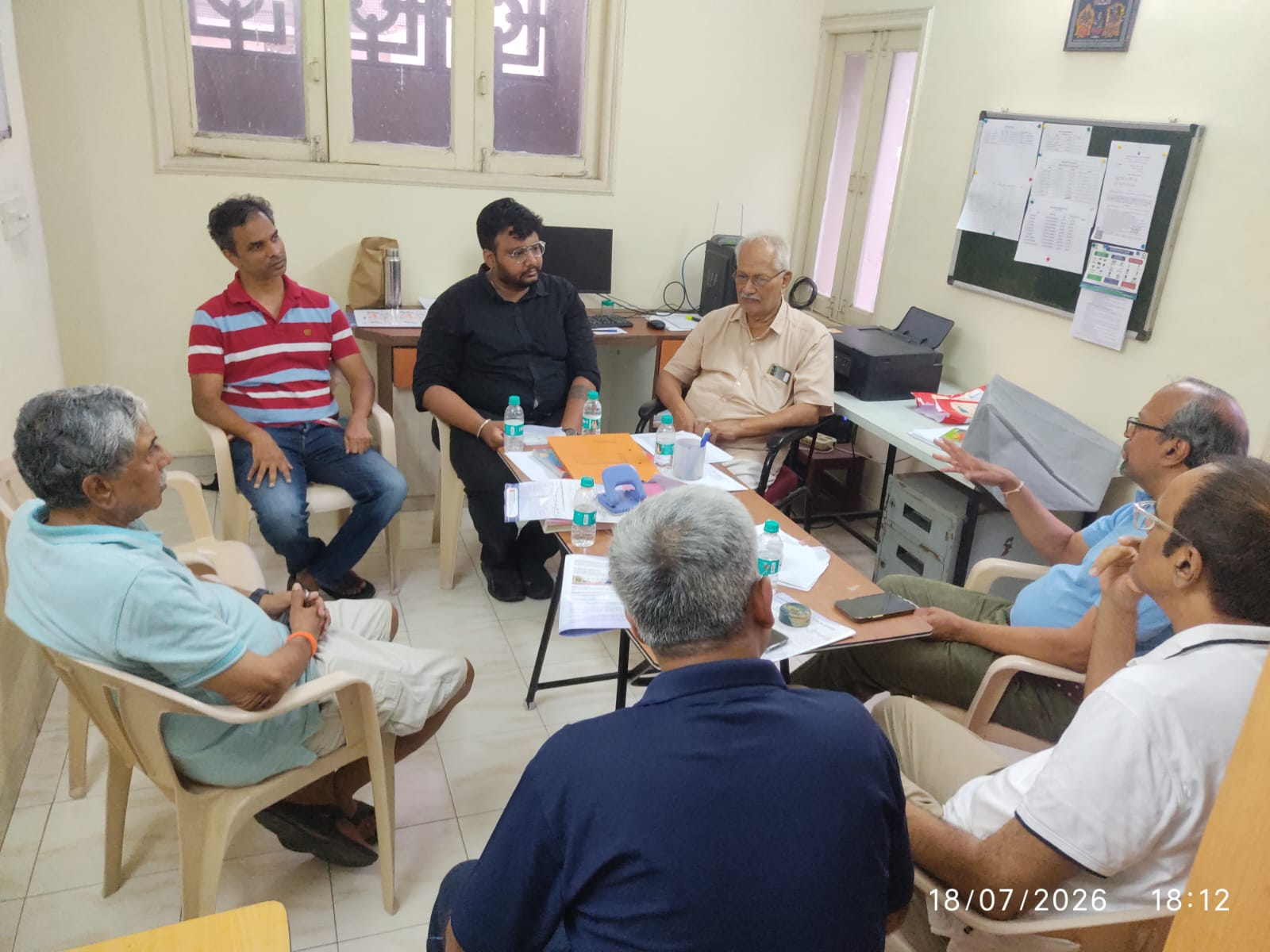
Mr. Subramani, Researcher (CAG), interacting with members of Abbotsbury Apartments during the session.
Session summary:
The session was conducted by Subramani, Researcher, Vishnu Rao, Programme Lead (CAG), and Aswin, Consultant, from CAG. The interactive session encouraged participants to openly discuss the feasibility of rooftop solar installations in their apartment complexes and seek clarification on technical, financial, and implementation-related aspects.
The session covered the following topics:
* Introduction to rooftop solar PV systems and their benefits.
* Types of rooftop solar systems suitable for residential buildings.
* Space requirements and installation considerations for apartment complexes.
* Financial aspects, including installation costs and subsidies available under the PM Surya Ghar: Muft Bijli Yojana.
* Net metering and electricity bill savings.
* System maintenance, safety, and expected payback period.
* Key factors to consider while selecting MNRE-approved vendors and planning installation.
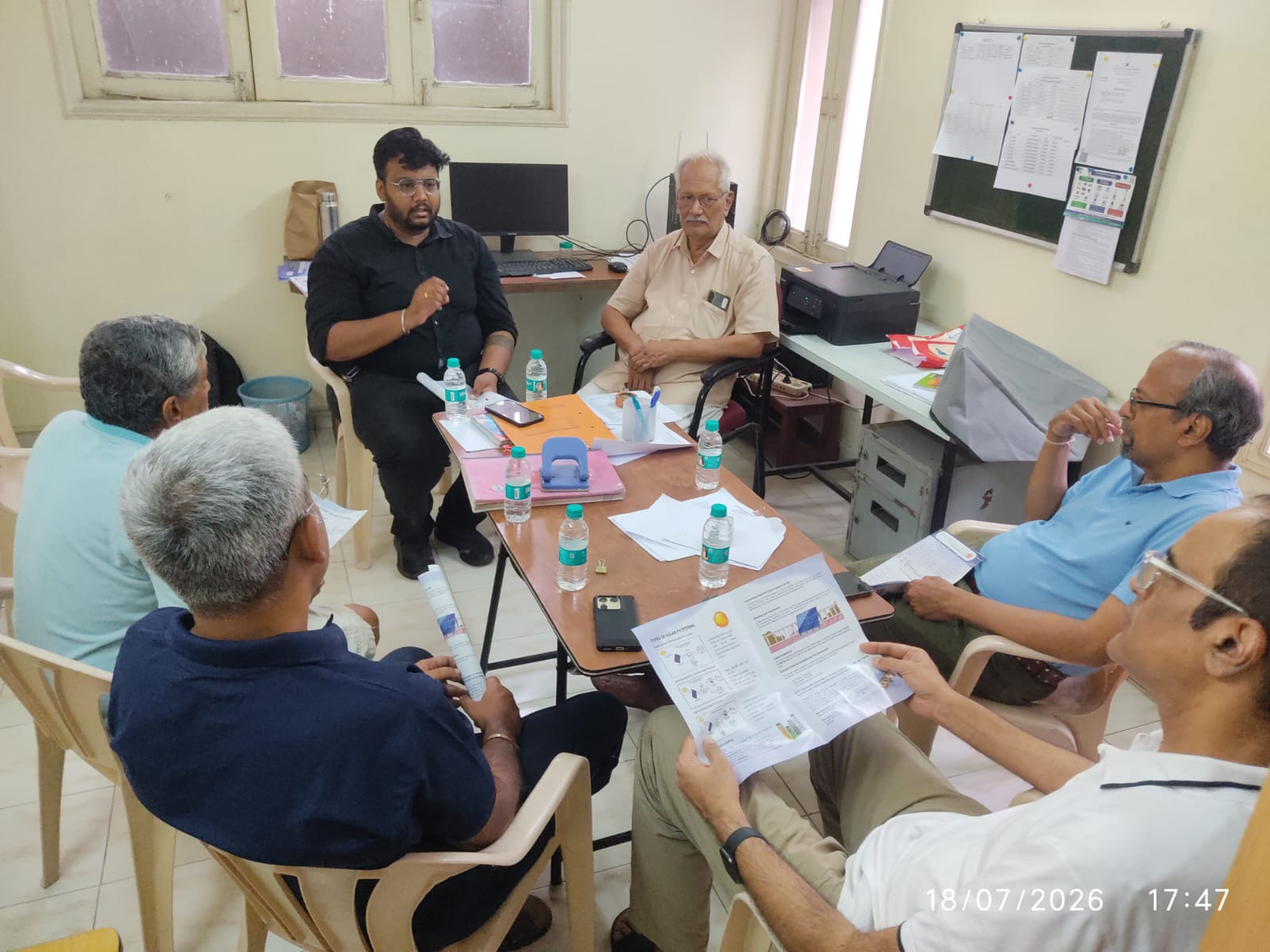
Residents engaging in the session
Participant Queries
Participants actively engaged in the discussion and raised several questions regarding rooftop solar implementation in apartments. The major queries included:
1. If some cells in a solar panel get damaged, how do we know the yield has dropped?
It was explained that the output of each panel is monitored. If a panel or a section gives less power than expected for the sunlight it receives, the drop will show in the generation data. The Performance Ratio is also tracked. This compares the power the system actually generates with the power it should generate for the available sunlight. If this ratio falls when there is no change in weather, it points to a fault. A thermal camera can then be used to locate the damaged cell as a "hot spot" and confirm the problem before it affects the overall output.
2. If we install solar, can we reduce or replace the genset, or do we still need it as before?
Participants were informed that the genset will still be needed. Solar cannot replace it, but it can reduce how often the genset is used. A standard grid-connected solar system switches off during a power cut for safety reasons, so it cannot supply power when the grid is down. If battery backup is added, the batteries can manage short power cuts, and the genset will be needed only for longer power cuts or when the battery charge is low. This reduces genset running hours and diesel costs. Without a battery, genset use will remain about the same, since solar generates power only during daytime hours, when grid supply is normally available.
3. With a hybrid solar-battery system, can we recover the investment quickly and save on genset costs?
It was explained that a hybrid system helps recover the investment faster, as it saves money in two ways: lower electricity bills and lower diesel consumption by the genset. Since running a diesel genset costs much more than solar or grid power, fewer genset hours shorten the payback period, typically to around 4 to 6 years.
4. How is the electricity generated from a common rooftop solar system shared among residents?
It was explained that the generated electricity can be used for common area loads such as lifts, lighting, pumps and other shared facilities. The exact arrangement depends on the chosen system configuration and applicable regulations.
5. For elevated mounting, will the extra columns and structural work be quoted upfront, or could the vendor add it later as a surprise cost?
Participants were advised that this cost should be quoted upfront. A reliable vendor will visit the site, check the structural strength of the terrace and include the cost of columns and structural work in the written quotation before work begins. The association should insist on an itemized quotation that lists the mounting structure, columns and civil work separately, and ensure that it is included in the contract. If these costs are not clearly stated in writing beforehand, the vendor may add them later as extra costs. The association should therefore confirm them in advance and not depend on verbal assurances.
Rooftop Solar Feasibility Assessment
Following the interaction, CAG prepared a preliminary rooftop solar feasibility assessment for the apartment complex, based on the electricity consumption of its eight service connections. The assessment estimated the rooftop solar PV capacity the complex would need, along with the likely cost, subsidy, bill savings and payback period. The key findings are:
* The eight service connections together consume about 54,447 units a year (around 149 units a day) and have a combined annual electricity bill of ₹6,42,397.
* A rooftop solar PV system of about 33 kW is estimated to meet this requirement.
* The estimated cost of the plant is ₹23,10,000 (at ₹70,000 per kW). The eligible subsidy is ₹5,94,000 (at ₹18,000 per kW), bringing the net investment to ₹17,16,000.
* The estimated annual saving on the electricity bill after installing solar is ₹4,04,350, giving a payback period of about 4.2 years.
* The assessment also looks at changes to the sanctioned load of individual connections (for example, an increase for two connections and a reduction for one) and how these affect the post-solar electricity bill.
The figures are indicative estimates meant to help the association decide on its next steps, and will need to be confirmed through a site visit and vendor quotations.
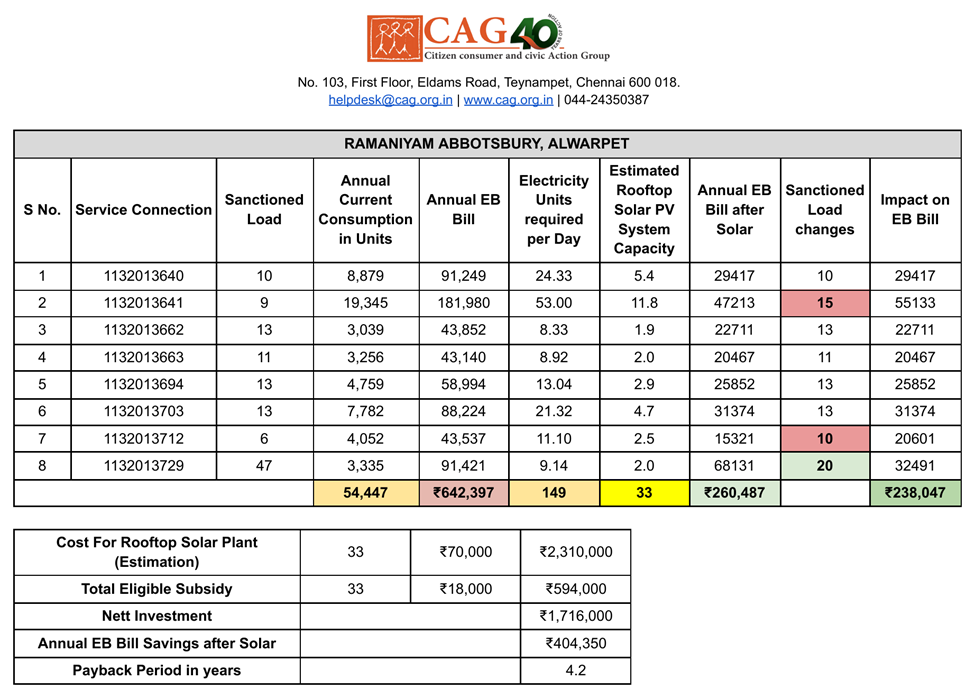
Rooftop solar feasibility assessment for Ramaniyam Abbotsbury, Alwarpet, prepared by CAG.
Feedback and Conclusion
Participants found the session highly informative, particularly in understanding the technical, financial, and practical aspects of rooftop solar adoption for apartment communities. The meeting helped address their concerns regarding installation, subsidies, net metering, and maintenance, enabling them to make more informed decisions.
The apartment association members expressed a strong interest in exploring the installation of a rooftop solar PV system for their premises and emerged as potential candidates for adoption. They indicated that they would further discuss the feasibility of the project within the association and evaluate the next steps towards implementation.
Participants were also informed about CAG's solar helpdesk for guidance on rooftop solar and related consumer support. The session ended on a positive note.