Marathwada is a dry region where rainfall is both low and unreliable. In a good year, it may get around 500 to 800 mm of rain, but even that doesn’t come evenly. There are long dry spells in between, and sometimes heavy rains come all at once and damage crops instead of helping them. Because the region sits in the rain shadow of the Western Ghats, it misses out on steady monsoon rains.
Over the years, circumstances have become tougher. Monsoons are delayed, summers are getting hotter, and droughts are more frequent. This also leads to water running off quickly during the monsoon instead of soaking into the soil, reducing percolation and lowering groundwater levels. All this leaves farmers with fewer options when rains fail, making farming uncertain and risky. These conditions particularly shine a light on why it is important to have more resilient and water-smart practices. The learnings from the Kisan Swaraj Sammelan (KSS) offer lessons from the crisis, mainly through a fundamental redesign of agriculture practices in Marathwada.
The Kisan Swaraj Sammelan 2026 was a major three-day national-level convention held from February 27 to March 1, 2026, at Karnataka State Open University in Mysuru. It brought together farmers, scientists, and NGOs from across India to promote organic farming, sustainable agriculture, and seed sovereignty. Discussions at the Sammelan made one thing clear - that rainfall is only part of the problem, the larger issue being how farming itself has changed over time. Soil has weakened due to excess fertiliser use and wrong cropping patterns, seed diversity has reduced and farmers are dependent on inputs they do not control anymore. Therefore, even a good monsoon season does not offer anticipated benefits to farmers. The idea of swaraj discussed at KSS focused on farmers having control over seeds, inputs, and decisions - without this level of control, farmers are likely to face uncertainty even into the future. To move in that direction, the learnings from KSS can be understood through a few key shifts. This transformation rests on three pillars: system redesign, seed sovereignty, and justice in coexistence and labour.
System Redesign: Restoring soil as a living system
The future of farming in Marathwada lies in shifting from input intensive agriculture to ecology-based systems. Agriculture must be understood as a living network, where soil, plants, animals, and humans are deeply interconnected. The first thing to understand is that soil is a biological engine that drives nutrient exchange, water retention, and crop resilience. It is often treated as an inert, non-living medium. In drought prone regions like Marathwada, restoring soil organic matter becomes the first line of defence against climate stress.
Farmers in Marathwada are often seen using fertilisers at large scale to increase their produce. But to bring back soil to its normal state requires a transition away from chemical heavy practices that further degrade soil microbiomes. Instead of focusing on eliminating weeds through herbicides, farmers can adopt Non-Pesticide Management (NPM) approaches. These rely on preventive and ecological strategies such as managing the weed seed bank, mulching, crop rotations, and the use of simple mechanical tools.
Another important point discussed at KSS was that not all weeds are useless. Many common weeds can actually be harvested and eaten, and some have good nutritional value. In earlier farming systems, these plants were part of local diets and livestock feed. Seeing them only as a problem is a relatively recent shift. Another important point of discussion at KSS was about herbicides, which are widely used by farmers. They are often seen as and portrayed as a labour-saving method, but its impact is deeper than what is generally visible. Over time, repeated use of herbicides weakens soil life, especially the microorganisms that help crops access nutrients and water. It also leads to a situation where some weeds survive and become resistant. Farmers then increase doses or mix chemicals, which raises costs without solving the problem.
There is also a social side to this. In many villages, weeding is done by women. When herbicides replace this work, women lose a source of income and access to fodder. At the same time, they continue to be exposed to chemicals while working in fields or washing equipment. So what looks like a simple solution ends up creating multiple new problems.
When farmers shift away from chemical intensive farming, the system begins to stabilise. Intercropping, especially with legumes, enhances soil fertility while also improving human nutritional outcomes among. Another important point discussed at KSS was that soil, crops, and human health are closely connected. When farming systems become less diverse, diets also become less diverse. This affects nutrition and immunity over time. So improving soil health is not just about increasing production, but also about improving the quality of food people eat. In this sense, soil health is an agricultural and public health concern.
Seed sovereignty: Climate resilience begins with control of inputs
In a region defined by climatic uncertainty, seeds are the first and most critical form of insurance. Traditional crop varieties, developed and conserved over generations, are inherently more resilient to local adverse conditions. They carry the ecological memory of the region and often outperform high-yielding varieties under adverse conditions. More importantly, they offer superior nutritional value. Crops grown from these varieties are often seen standing strong even under pest attacks. One concern raised at KSS was the sharp decline in crop diversity. Earlier, farmers grew many varieties suited to different conditions. Today, a small number of varieties dominate large areas. This makes farming more vulnerable. When all farmers grow similar crops, one extreme weather event can affect everyone at the same time. For a region like Marathwada, this increases risk significantly.
Seed sovereignty is all about restoring farmers' control over seeds, the most essential input. Community led seed banks, particularly those managed by women, can play a transformative role in reducing dependence on commercial seed systems. Such initiatives will enable the conservation, exchange, and revival of indigenous varieties. Even at KSS it was seen that women ran stalls of indigenous seed banks. From vegetables which are often ignored, millets, rice varieties to everything that was part of the traditional food ecosystem was present and preserved by them. Such examples made us believe that indigenous seeds can be brought back and can be scaled, provided we create systematic support and strategies to mainstream such initiatives.These examples show that farmers are users, producers, and custodians of seeds.
It is equally important to recognise farmers’ rights to save, share, and sell seeds. Protecting these rights is essential for maintaining genetic diversity, which is the foundation of climate adaptation. This practice isn't new and has been carried forward by many farmers for a long time.
Successful initiatives across India (for example, KSS) have shown that linking traditional seed revival with local markets, through mela stalls and farmer collectives can make conservation both viable and profitable. Many people chose to carry seeds from KSS back home which shows trust in farmers, SHGs and collectives that has been developed over time. They did not need any large marketing effort to sell these seeds. It was a double benefit, people were getting traditional seeds and at the same time those who built these seed banks also earned enough in return. It's like creating a ripple of change through a simple act of care towards what matters. Participants from 7 to 8 states carried these seeds and knowledge back home to revive local seeds along with a determination to bring back seed sovereignty. This is where many good ideas fail if not supported properly. Even if farmers adopt these practices, they will not sustain unless markets support them.
Markets: Making this transformation work
One important gap that often comes up is about markets. Farmers will only shift practices if it makes economic sense. At KSS, there were several examples where farmers connected directly with consumers through local markets, seed melas, and collectives. This helped them get better prices and reduce dependence on middlemen. For Marathwada, building such local market linkages is important, especially for crops like millets, pulses, and oilseeds which are well suited to the region. Without market support, even good practices will remain limited.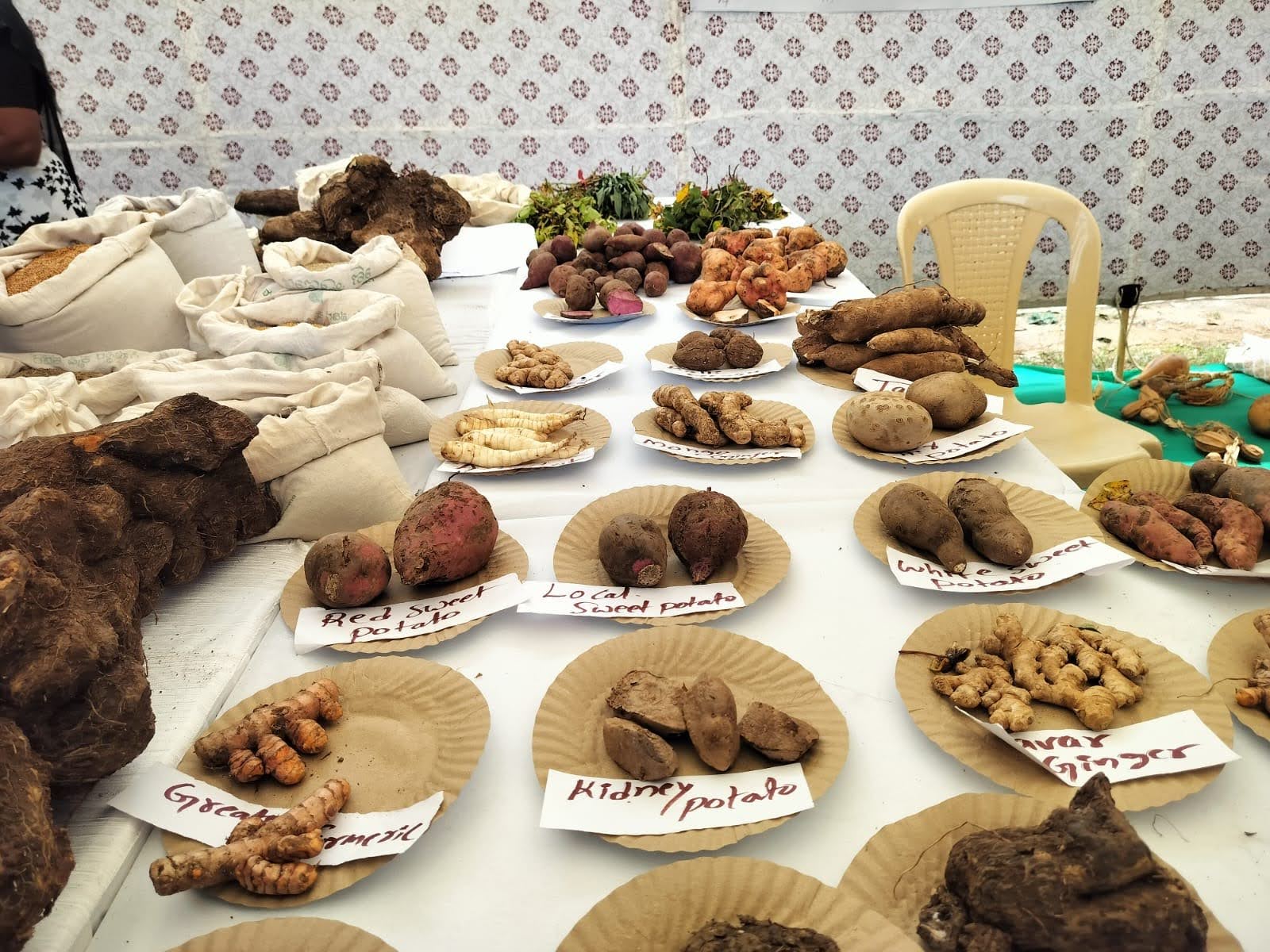
Different types of traditional root vegetables being conserved by seedbanks.
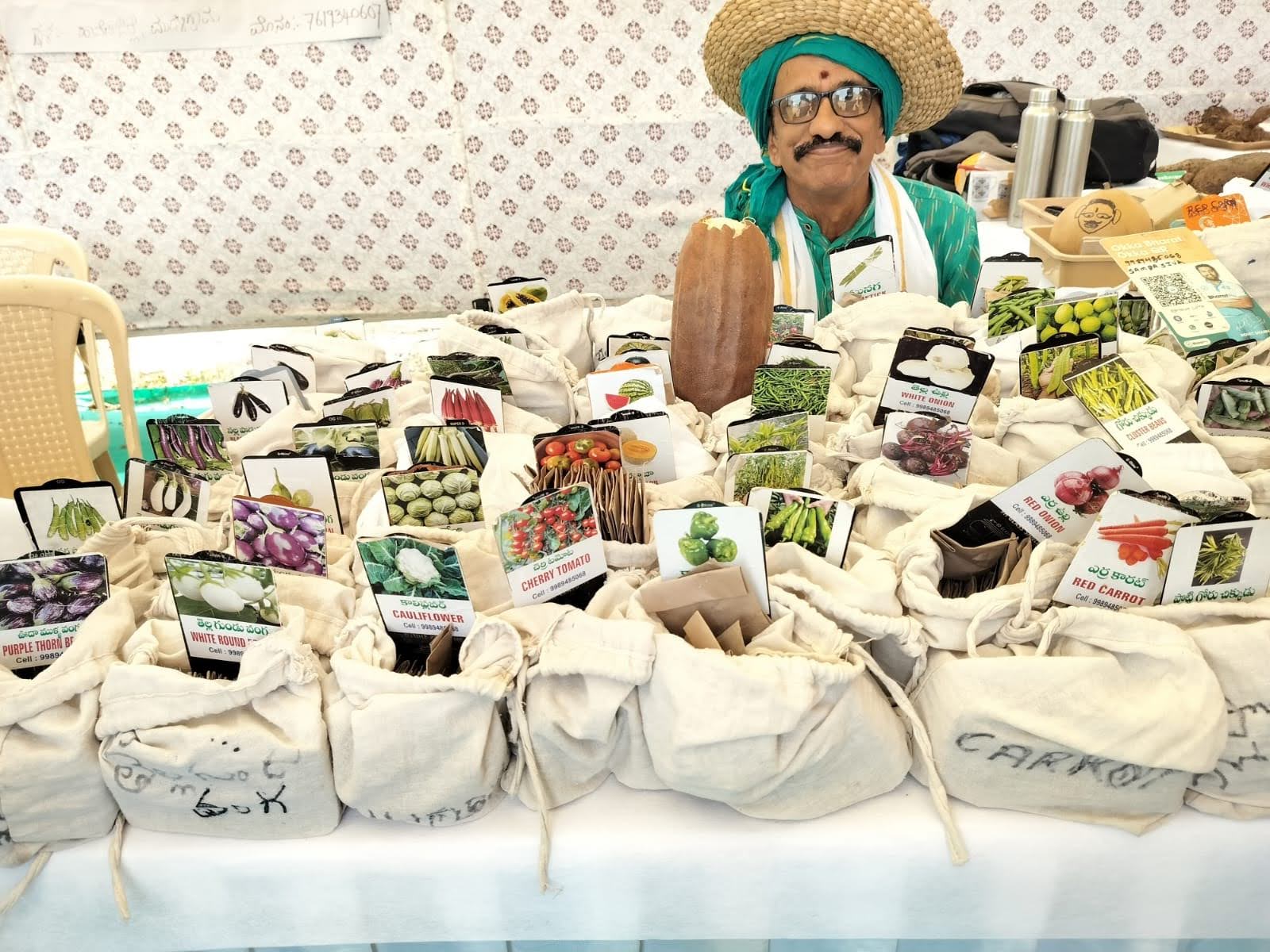
Farmer selling collection of seeds of indigenous varieties
Coexistence and Labor: Towards a just agrarian system
Marathwada’s agrarian crisis is ecological as well as social. There are rising events of human-wildlife conflict, particularly with species like wild boars, blackbucks and in some cases leopards. This is reflecting deeper issues of habitat disruption (especially ecological imbalance) and policy gaps. These conflicts cannot be reduced to a farmer versus animal narrative anymore. They require systemic solutions that include better planning, governance, and shared responsibility. Some practical solutions discussed at KSS include the use of bio-acoustic devices that use sound to deter animals, solar fencing, and planting border crops that animals tend to avoid. These methods help protect crops without harming wildlife and can be adapted based on local conditions. One interesting point raised at KSS was that animals quickly get used to any single type of deterrent. They are fast learners. This means farmers cannot rely on just one method. There is a need to update approaches, adapting to local conditions, and, more importantly, learning to coexist.
In many cases, spending more time observing and being present on the farm itself becomes part of the solution. At the same time, compensation mechanisms must be timely, fair, and reliable. In many parts of Marathwada, farmers are shifting their cropping choices to avoid destruction and crop loss because of wild boars. This has important consequences for what will be grown and how much will be produced by farmers. The net effect of this is primarily felt in a farmer’s income, at a time when it is already stressed.
It is equally important to address the region’s labour crisis. Large communities of people migrate from Marathwada to West Maharashtra or other states for livelihood. This migration is a socio economic issue as well as socio political one. Large numbers among migrants belong to marginalised communities stuck in a spiral loop of debt. Such migrations are weakening the farming system itself. When farming becomes uncertain, families are forced to look for work elsewhere. This affects income as well as social structures in villages. Women and marginalised communities are often the most affected.
Agricultural labor must be recognised as skilled work, with wages and protections that reflect its importance. This seems impractical but at the same time it is very important. Public support systems like insurance and disaster relief must reach the actual cultivators, especially tenant farmers, women, and landless workers, rather than being limited to landowners. This will require structural, administrative reforms.
What can be done in Marathwada at different layers:
The learnings from KSS are not difficult to start. Many of them can begin at a small level. At the farm level, farmers can start observing soil and weeds more closely, reduce chemical use gradually, and bring back intercropping. Saving even small quantities of traditional seeds can be a starting point.
Parallely, at the community level, forming small seed groups, exchanging seeds, and sharing knowledge can strengthen local systems. And at a larger level, there is a need to support seed banks, include traditional crops in government schemes, and improve compensation systems for farmers facing losses.
Conclusion: From Vulnerability to Agroecological Strength
The transition ahead is about advancing towards agroecological culture by rebuilding soil biology, reclaiming local control over seeds, and demanding justice in labor and ecological governance. Marathwada can really move beyond survival by building a farming system that is resilient, equitable, and grounded in its ecological realities. This will be an agricultural shift with a way to restore dignity, autonomy, and long-term sustainability in one of India’s most climate-stressed regions.