With quotes from Jane Jacobs
“It may be that we have become so feckless as a people that we no longer care how things work, but only what kind of quick, easy outer impression they give. If so, there is little hope for our cities or probably for much else in our society. But I do not think this is so.” - Jane Jacobs
The Jane’s Walk honours Jane Jacobs - a writer, activist, and urban planner who believed that cities should be designed around people - with safe streets, walkable neighbourhoods, and spaces where communities can come together. Through her work, she showed that everyday life on the streets holds the key to creating better cities. Her legacy is honoured in May, her birthday month, by communities around the world who organise walks in their neighbourhoods or around their cities.
In May this year, CAGs sustainable mobility team led a Jane’s Walk along a 4-kilometre stretch starting from the MGR Janaki college, across the Adyar river, and then into Besant Avenue along the much-vaunted health walk and ending up at a café in Besant Nagar. This route felt perfect for this year’s theme – STEP – stories, travel, ecology and places as it led us along a historically rich stretch that traversed a river, estuary, the Theosophical Society and even a stretch that appears on Chennai’s list of (allegedly) haunted streets! But this was not meant to be just a heritage walk – our purpose was to examine the accessibility of street infrastructure for pedestrians including wheelchair users.
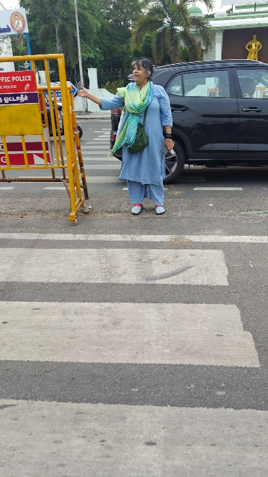
Crossing the road at the MGR Janaki bus stop is a misadventure in itself! | CAG
Our group of students, journalists, disability rights activists, researchers, ranging in age from 18-60 met at the bus stop outside MGR Janaki college at 5 pm. Our participants on wheelchairs were to meet us at the beginning of Besant Avenue and our group split into two so that we could walk along both sides of the road – and our first hurdle appeared as some of us attempted to cross the road. Yes, there was a zebra crossing but little else and with traffic coming at us constantly with no sign of slowing down or stopping, getting to the other side felt like an adventure sport we hadn’t signed up for. This felt particularly jarring as this is the only place that allows for crossing before getting onto the Adyar bridge.
The second section of our walk was over the Adyar bridge – on one side the river, the other side the estuary blocked from view by the historic Broken Bridge. The footpath on the bridge is inaccessible to wheelchair users and is also riddled with wires and broken or jutting stones. The view from the side overlooking the river is pleasant – and one can often see people stopping their two-wheelers here to look at the sunset over the river. While this is a good spot to catch glimpses of bird life on the water, the garbage piled along the riverbank is a depressing sight indeed.
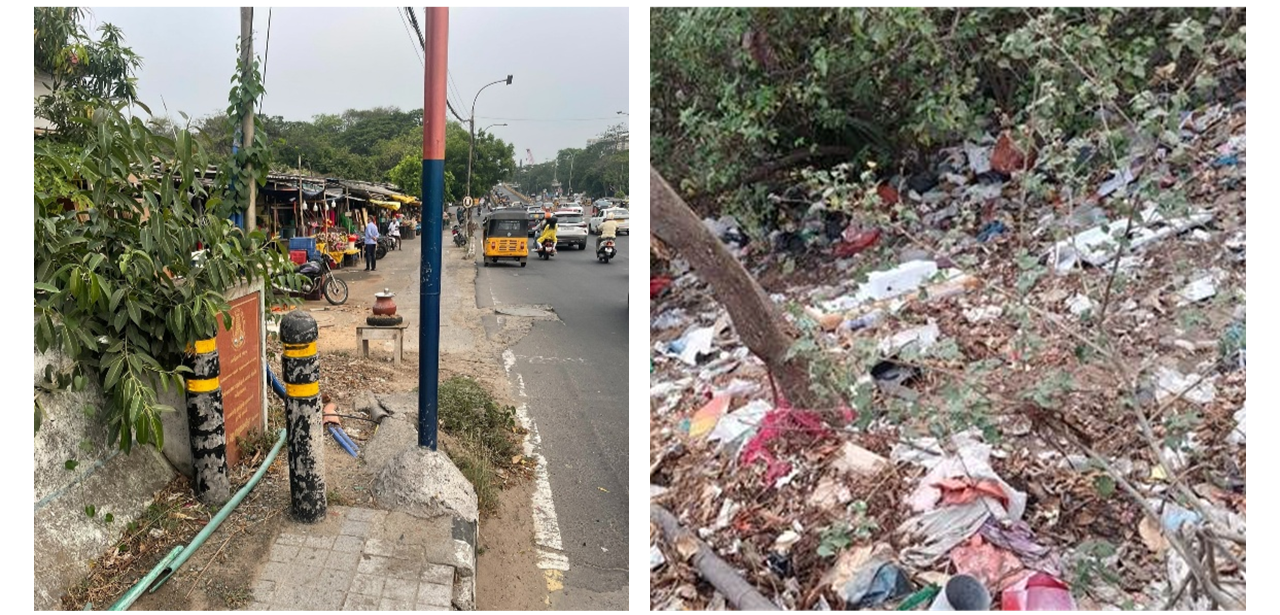 Broken pavements along the bridge and garbage on the river bank | CAG
On the other side of the bridge there was yet another struggle to cross the road under the flyover to reach the beginning of Besant Avenue, which is also the starting point of the health walk, inaugurated in 2023. We were joined by our participants on wheelchairs here.
The pictures speak for themselves: the footpaths are literally unusable at many points along this stretch - broken tiles, encroached by toilets and power transmitters leaving very little space to walk, garbage cans blocking our way, forcing our participants on wheelchairs to use the carriageway instead.
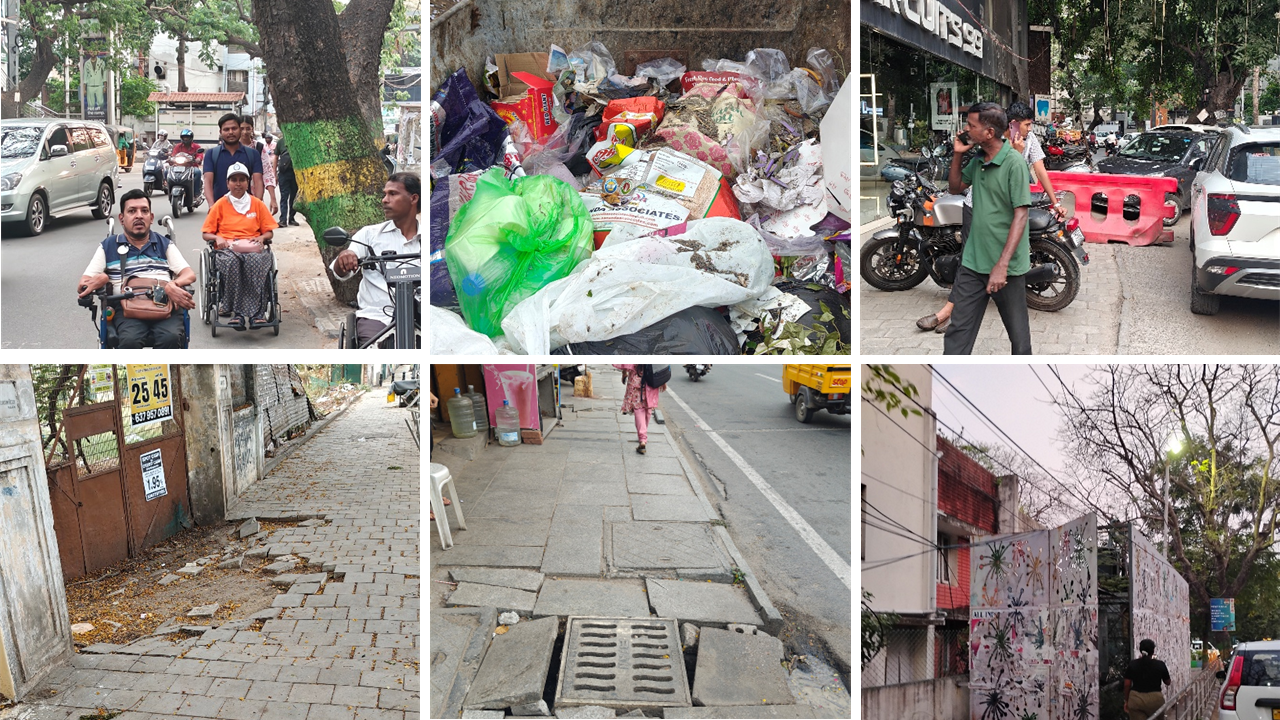
State of footpaths on the health walk stretch of Besant Avenue | CAG
While struggling to keep myself off the carriageway and stick to the footpath, I could not help but ask myself for the hundredth time – who are we designing our cities for? If this stretch, meant expressly for pedestrians, in an elite neighbourhood, is in such poor condition, what are other neighbourhoods like? With its thick canopy, the Besant Avenue is considerably cooler than less shaded streets at any time of day. It should be a walker’s delight – a street that can be used by everyone – and indeed it was designed to be so. However, where are the unobstructed and accessible footpaths? At regular intervals along the street, there are signs that encourage cycling – but are cyclists safe here? Is there a separate path for cyclists? These are rhetorical questions because of course the answers are no.
“Any architectural design that increases the chance that a potential offender will be seen is a form of natural surveillance. Often it is not just that the offender might be seen that matters; that the offender thinks they will be seen can deter crime.” - Jane Jacobs
Safety was another issue that came up. We started our walk at 5 pm and as dusk approached the streets were considerably darker. Our group, especially the participants who took the Blue Cross Road felt that this stretch would not feel safe for a woman walking by herself. The absence of street lighting as well as CCTV cameras was deeply felt.
“Streets and their sidewalks-the main public places of a city-are its most vital organs.” - Jane Jacobs
Last year, the Supreme Court recognised the rights of pedestrians and emphasised that safe, unobstructed and accessible footpaths are part of pedestrians’ rights and directed States and Union Territories to create guidelines, remove encroachments, and ensure footpaths are usable, including for persons with disabilities. This year, it has gone a step further and ruled that the right to walk on safe, demarcated footpaths is a fundamental right protected under Articles 19(1)(d) and 21 of the Constitution. It stated that pedestrian movement is primary and must take priority over motor vehicles, placing a duty on authorities to build and maintain proper footpaths, therefore treating pedestrian infrastructure not just as a safety requirement, but as a constitutional obligation and a matter of citizens’ rights. The Supreme Court’s statements seem even more crucial when seen against the backdrop of pedestrian involvement in road crashes – according to MoRTH’s 2024 report, Tamil Nadu tops the country in terms of pedestrian deaths. In Chennai, upto June 2025, 816 pedestrians were involved in crashes of whom 190 were killed.
“Not TV or illegal drugs but the automobile has been the chief destroyer of American communities.” - Jane Jacobs
Jane Jacob’s words on American cities rings true for Chennai too – why do we not walk? Indeed, why would we when the mere act of walking is fraught with risk? When the most basic of street infrastructure – the footpath – is neither accessible nor continuous and very often not even present! Yet, walking and cycling through the city is what brings familiarity with one’s hometown as it were, creates a feeling of community and well-being. Walking and cycling, when built into one’s lifestyle, also improve health indices. What do we have to lose when our cities become walkable? In short, nothing!
“Designing a dream city is easy; rebuilding a living one takes imagination.” - Jane Jacobs
On our Jane’s Walk group reflections, we found that despite all the challenges, the participants said that they would want to do more such walks across the city, and that walking along paths with natural elements made the walk more enjoyable. The Greater Chennai Corporation does have plans to improve pedestrian infrastructure – from removing encroachments, to procuring jet washers to clean footpaths and to construct 200 km of footpaths across the city. Our Jane's Walk is not about one evening's walk. We saw the city from the perspective of a pedestrian and a wheelchair user. Every broken pavement, unsafe crossing and inaccessible footpath reveals whose needs have been prioritised and whose have been ignored. With plans already in place and construction begun in some streets, Chennai has an opportunity to build differently. City authorities must recognise that better streets are not simply nicer amenities; they are public spaces that support health, safety, inclusion and community.
Jane Jacobs argued that cities succeed when they are designed around people rather than vehicles. An idea that remains as relevant as ever for Chennai.
---
Add new comment