It is just three months into the new year and already we have been confronted with a series of tragic road crashes.
Six teenagers died after their car collided with a truck in Hoskote. In Delhi, a young man on his way to work was killed when an SUV rammed into his motorcycle. In Mumbai, a 15 year old boy died after his scooter was struck by a speeding SUV. These tragedies share a disturbing common thread. In all three cases, the drivers were underage and so did not have a driver’s license. One driver lost his own life along with five of his friends; the others must now live with the knowledge that their recklessness cost another person their life.
Scale of the problem
According to the Ministry of Road Transport and Highways (MoRTH), minors were responsible for 11,890 road crashes in a single year; an average of 16 crashes every day. Tamil Nadu ranks highest in this category, reporting 2,063 crashes involving minors, or roughly three every day. Madhya Pradesh follows with 1,138 such crashes in 2023–24. Early indications suggest the problem is not abating. In Delhi alone, and in just 6 weeks since this year began, nine minors have already been prosecuted for unlicensed driving, almost double the number recorded during the same period last year.
Dr. Gayatri Devi, MBBS, Chennai says, “From a medical and behavioural perspective, children under 18 are still in a stage of brain development. The part of the brain responsible for judgment, self-control, and understanding risks which is called the prefrontal cortex does not fully mature until the early twenties.
Driving is not just a physical activity; it requires quick thinking, calm decision-making, and the ability to respond responsibly under pressure. Teenagers, by nature, are more likely to act impulsively, get easily distracted, feel overconfident, or be influenced by friends. These factors can seriously affect their ability to drive safely.
So, even if a minor seems physically capable of handling a vehicle, they may not yet have the mental maturity required for safe driving. Allowing them on the road puts not only their own lives at risk, but also the safety of others.”
Why we ignore the risk
One reason underage driving persists despite a clear legal framework is that people tend to underestimate everyday risks. Psychological research shows that individuals assume that negative outcomes are unlikely to happen to them, even when they are aware of the danger. This “it won’t happen to me” mindset or the optimism bias is reinforced by repeated uneventful experiences. Each safe ride makes risky behaviour feel normal and acceptable. This leads to overconfidence and normalising unsafe behaviour thus causing people to overestimate their own control and downplay the likelihood of harm, especially in everyday activities like driving. Both parents and young riders, therefore, begin to treat illegal driving not as a serious safety violation, but as low-risk convenience; until a crash forces them to deal with the fallout of their actions. Inconsistent enforcement and weak penalties could also reinforce this behaviour.
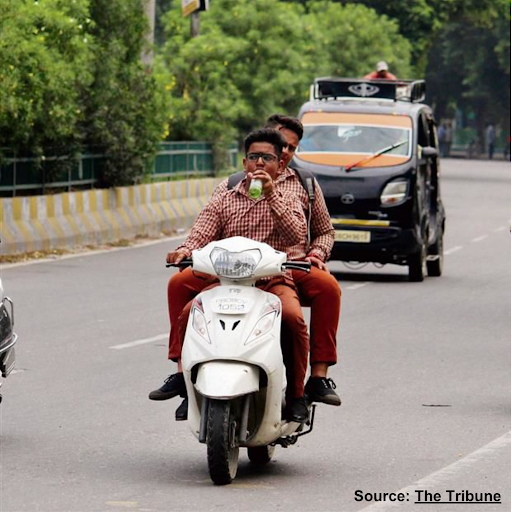
Low speed does not mean low risk
Speed is rightly assumed to be the primary determinant of danger, and research suggests that even modest increases in speed significantly increase the likelihood of serious injury. For example, the risk of severe injury rises sharply from 10-50% as speeds increase from around 30 km/h to 45 km/h.
This then raises important questions about our current regulations themselves, where certain low-speed electric two-wheelers that have a maximum speed of 25 km/h are exempt from licensing and registration requirements. (This exemption also applies to motorised two-wheelers under 50 cc). This means they can legally be operated on public roads without a driving licence or formal road safety training. A similar rule also applies to two-wheelers under 50cc. This creates an inherent contradiction in our regulatory framework. On the one hand, policymakers rightly recognise that adolescents lack the cognitive maturity and experience needed to safely operate motor vehicles. On the other hand, existing rules allow young riders to operate certain motorised vehicles without licensing or training, on public roads especially in the mixed traffic conditions of Indian roads.
Dr Aditi Mitra Ghosh, Transport Expert, IIT Kharagpur says, “Allowing 16-year-olds to ride gearless scooters/ mopeds up to 50cc comes with clear risks -limited experience, slower vehicles struggling in faster traffic, and the natural impulsiveness of teenagers - all increase the chance of accidents. Even at speeds below 30 km/h, a sudden brake, skid on uneven roads, or delayed reaction can throw a young rider off balance, leading to head injuries or fractures, while pedestrians struck at such speeds can still suffer serious harm, especially in crowded cities. Without proper training and mandatory safety gear, these factors can quickly turn dangerous, highlighting that responsibility and preparation matter as much as permission.”
Other countries are rethinking their regulations too
The growing number of e-bikes on our roads is a global phenomenon. On principle, this is a good thing as it signals a move towards cleaner transport. However, with e-bike options being available to children who are not trained in driving on the roads could lead to dangerous crashes. Many nations are reviewing their regulations on unlicensed vehicles. In Austria for example, a child as young as 9 can ride an e-scooter but they need a bike pass to do so – and must be accompanied by a person who is 16 years or older. Helmets are also mandatory for younger riders of e-scooters. Many EU nations also mandate that these bikes are allowed only on the specific lanes meant for them and are not allowed in mixed traffic conditions.
Mixed signals with missing data?
The MoRTH 2023 data reports that two-wheeler riders account for 45% of all road fatalities in India. 48,818 lives were lost due to these vehicles among whom 9,951 were pedestrians. In Tamil Nadu, 8,113 two-wheeler deaths were recorded, amounting to 44% of the road crashes (18,347) in the state.
There is no data on either how many of these two-wheelers are those that do not require a license, or on the age of the rider which is unfortunate because it is difficult then to establish a link between underage or unlicensed driving and road crashes. We need data that dives deeper into the age of the driver and the type of vehicle they are driving, so that policy responses are grounded in evidence and targeted at the most significant sources of risk.
Enforcement on the ground
Against this backdrop, enforcement agencies have begun focusing more directly on underage driving. Chennai traffic police are now arresting and remanding parents of underage drivers to discourage children from driving. According to the Motor Vehicles Act, the parent of a minor involved in an accident can face imprisonment of up to three years and a fine of ₹25,000. Underage driving is difficult to enforce and more often than not, this violation comes to light only after a crash has occurred.
A member of Chennai’s traffic police says, “Electric two-wheelers with a motor power of up to 250 watts and a maximum speed of 25 kmph are exempt from registration and do not require a driving licence. However, this does not mean that children can use them freely on public roads.
The age restrictions under the Motor Vehicles Act still apply, and minors below the permitted age are not allowed to ride such vehicles. If underage children are found using these vehicles, the responsibility will lie with the parents or guardians, and appropriate action can be taken against them.”
How can authorities prevent underage driving?
- Firstly, there should be no confusion as to what kind of vehicles children are allowed to drive on our roads. A blanket rule that applies to all motorised vehicles must be applied to children below 18. If that is seen as extreme, restrictions on where low speed e-bikes can operate must be put in place.
- RTOs need to ensure that licenses for 2 and 4 wheelers are only given after very stringent testing that follows global standards.
- Penalties must be so severe that they act as a deterrent, especially for the parents or guardians of the child.
- Data should be available on whether crashes involve low-speed EVs, bikes below 50 cc, and the age range of underage drivers of both 2 and 4 wheelers. This would be a critical factor in building a fact-based narrative around underaged driving in the public domain.
If we say that adolescents are still developing the skills needed for safe driving, the question is not about whether they should be allowed on certain vehicles, but under what conditions. Other countries have addressed this by permitting limited use with supervision or strict operational boundaries, an approach that perhaps India could look at to control rampant driving/riding by those who are not yet old enough for a license. Additionally, we need strict enforcement of laws that are already in place that prevent minors from using other, more powerful motor vehicles.
Until we ensure that every vehicle user, be it a car or low speed bike is trained to understand road safety principles, every crash involving an underage rider will raise the same uncomfortable question: is this a serious road safety issue, or are we normalising it as an acceptable condition of Indian roads?
---
Add new comment