170000. One hundred and seventy thousand. Each of these numbers has a name. A name that’s precious to a circle; to whom this person represented more than a statistic. This number represents the total number of lives lost on our roads in 2025, working out to 465 lives a day. Unfortunately, this number along with other data about why and how these crashes occur are not a part of our general perceptions about safety and risk assessments. We wanted to platform this critical discussion during Road Safety Month that is observed from January 1-31. To bring this into focus and to bring young people into the discussion, CAG hosted an Ideathon on road safety where we invited multi-disciplinary college level teams to bring their ideas and solutions to the table.
Our idea behind involving young people was to bring the urgency of the situation home to them – after all, young people are critically impacted by road crashes with those aged between 18-45 being the most affected group.
To guide the Ideathon, students were asked to respond to five broad problem areas that reflect some of the most pressing road safety challenges in Tamil Nadu.
The first focused on speeding hotspots, encouraging students to identify high-risk locations around campuses or neighbourhoods and develop solutions using affordable technologies such as sensors, mobile applications, or AI tools to detect speed violations, generate real-time alerts for drivers or enforcement agencies, and suggest traffic calming design measures.
A second problem statement addressed behaviour change among two-wheeler riders, inviting ideas such as apps, campaigns, or wearable technologies that could increase helmet use, discourage mobile phone use while riding, and encourage safer speeds.
The third theme examined speed management on highways in Tamil Nadu, asking students to propose a mix of low-cost engineering interventions, technology-based monitoring systems, and awareness initiatives, particularly for commercial drivers who form a large share of highway traffic.
Recognising that long-term change must begin with awareness, the fourth theme encouraged students to reimagine road safety education through engaging digital formats such as games, virtual reality modules, chatbots, or social media tools that help young people understand the consequences of speeding, adopt safe driving behaviours, and learn basic emergency response skills.
Finally, the fifth theme focused on enhancing safety for non-motorised transport users, inviting proposals that improve safety and accessibility for pedestrians and cyclists through better infrastructure such as sidewalks and protected crossings, technology-enabled tools to identify unsafe zones or guide route planning, and behavioural campaigns that promote mutual respect among all road users.
Together, these themes encouraged participants to think across engineering, technology, education, and behavioural change to address road safety from multiple perspectives.
Unsurprisingly many sensor and app-based solutions were presented to us. One team came up with the idea of a sensor-based device that would gauge when the driver fell asleep and wake them up with an audio signal. Another rather futuristic idea imagined roads as sentient beings that would respond to different weather conditions, detect the speed of vehicles as well as pedestrian activity and even clean the air as vehicular emissions are released!
We shortlisted 8 entries, all of which drew from personal experiences on the road as drivers and pedestrians. One team came up with a two-wheeler that would not start if it sensed more than 2 people sitting on it – thus addressing the all-pervasive ‘’triples’’ or even more on bikes. Another team worked on ‘after’ pictures of congested accident-prone spots such as bus termini in Coimbatore and worked on solutions that would keep pedestrians safe while maintaining a smooth flow of traffic there. A Chennai based team spoke of their personal pedestrian experiences while walking to college and came up with solutions to encourage and protect vulnerable road users. Interestingly, no proposal suggested road widening or flyovers – perhaps the students know something that the powers that be have yet to figure out!
The winning team from Government Law College, Dharmapuri, proposed a three-pronged approach combining engineering, technology, and awareness. Their proposal included simple, low-cost engineering measures like optical speed bars and transverse rumble strips designed to encourage drivers to slow down. This was complemented by technology-based monitoring tools, including multi-lane speed detection systems that could be integrated with the e-challan system to strengthen enforcement. Recognising that many speeding violations on highways involve commercial vehicles, the team also suggested targeted training programmes and incentive schemes for fleet operators to encourage safer driving practices, thus addressing the problem in a holistic and practical manner.
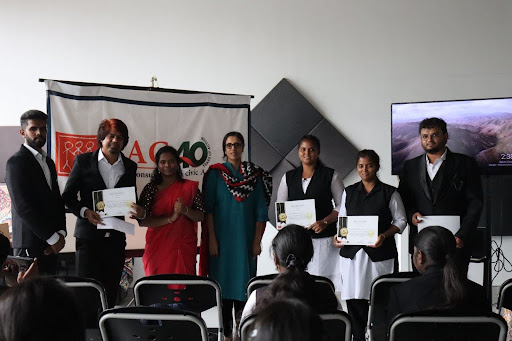
The team (M.A. Mannan, M. Chandrababu, G.C. Annilai Sivaranjani, S.Mohammed Salman, K.Kalaiyarasi and B.K. Ramya Krishnan) from Government Law College, Dharmapuri was the winner of this Ideathon.
The first runner-up from the School of Excellence in Law at the Tamil Nadu Dr. Ambedkar Law University, focused on improving road safety among young drivers, a group that is at highest risk of road crashes. The students pointed out that conventional road safety education tends to be theoretical and tedious and often fails to leave a lasting impact. Their solution sought to make safety education more engaging and experiential. They proposed a mobile application that tracks driving behaviour and provides users with alerts and feedback on unsafe practices such as speeding or sudden braking. The app also incorporated a gamified element, allowing young drivers to earn safety points and certificates for responsible driving, which they could share on social media, thus influencing their peers in a positive manner. By linking safer driving with recognition and positive reinforcement, the team aimed to encourage long-term behavioural change among young road users.
The second runner-up, also from the School of Excellence in Law, Chennai, approached the challenge of highway speeding through a strong evidence-based lens. The team conducted a primary field survey to better understand speeding patterns and identify potential interventions. Building on these insights, they proposed a set of practical and affordable engineering solutions, including optical speed bars, smart rumble strips, and dynamic speed feedback boards that display drivers’ speeds in real time. Their proposal demonstrated how relatively simple infrastructure measures, informed by local data, could influence driver behaviour and improve safety outcomes while remaining cost-effective to implement.
At the start of this article, we spoke about the number 170,000, the lives lost on India’s roads in a single year. If we also look at even more lives that are severely injured, the depth of the problem seems overwhelming, but initiatives like the Ideathon demonstrate that solutions often begin with fresh perspectives and a different way of approaching a problem.
The participants did more than present ideas. They examined data, reflected on their own experiences as road users, and attempted to design practical solutions that could make our roads safer. In doing so, they became part of a much larger conversation about responsibility, safety, and the future of mobility in India. One that we hope they take forward to their peers and in their own lives while driving or using the road.
Road safety is often framed as a problem for governments and enforcement agencies alone. And for the most part, it is. But as the Ideathon demonstrated, safer roads also depend on informed citizens, engaged communities, and young people willing to imagine better systems.
---
Add new comment