Over the past few months, global tensions and shipping uncertainties have contributed to shockwaves through global energy markets. India imports roughly 60% of its LPG demand; these global shipping delays have severely impacted local distribution. With Liquefied petroleum gas (LPG) shortages disrupting daily cooking, many households are turning to electric alternatives. What appears to be a temporary adjustment is, in fact, a significant transition with deep implications for affordability and energy conservation.
For decades, LPG has been the dominant cooking fuel in Indian households, due to its convenience and reliability. However, recent supply disruptions have reduced LPG availability and increased waiting times. In some areas, households report waiting periods of up to 25–35 days for a single refill. Electric cooking appliances are increasingly becoming an important option. This has pushed households, especially urban and peri-urban consumers, towards electric cooking.
In March 2026 alone, domestic LPG prices in Chennai jumped by Rs. 60, bringing the cost of a 14.2 kg cylinder to approximately Rs. 928.50. Recent retail data from March 2026 shows that the change we’re seeing is not just a slow trend anymore. Major e-commerce platforms like Amazon India reported a 20-fold jump in induction stove sales in a single 24-hour window following news of West Asian supply disruptions. Flipkart noted that sales volumes tripled within one week as consumers "hedged" against future LPG volatility. Beyond stoves, electric pressure cookers and rice cookers saw a 4 times increase in demand, while electric kettles used to offload gas usage for boiling water saw sales double.
How do LPG stoves & Induction Cooktops work?
An LPG stove works by burning liquefied petroleum gas to produce a flame. Heat is transferred from the flame to the cookware due to which some energy is lost to the surrounding air. In an induction cooktop, electricity is used to generate a magnetic field. The cookware itself heats up directly, making it more energy-efficient than traditional gas stoves.
Efficiency - LPG stove Vs Induction Cooktops:
To understand this better, consider a standard 14.2 kg LPG cylinder, which contains approximately 198 kWh of energy (about 7,10,000 kJ). However, due to the limited efficiency of LPG stoves, only about 40-60% of this energy is actually useful for cooking. This means the effective usable energy is roughly 120 kWh (or 120 units). In other words, even though a household pays for the full energy content of the LPG cylinder, nearly 50% of it is lost during the cooking process.
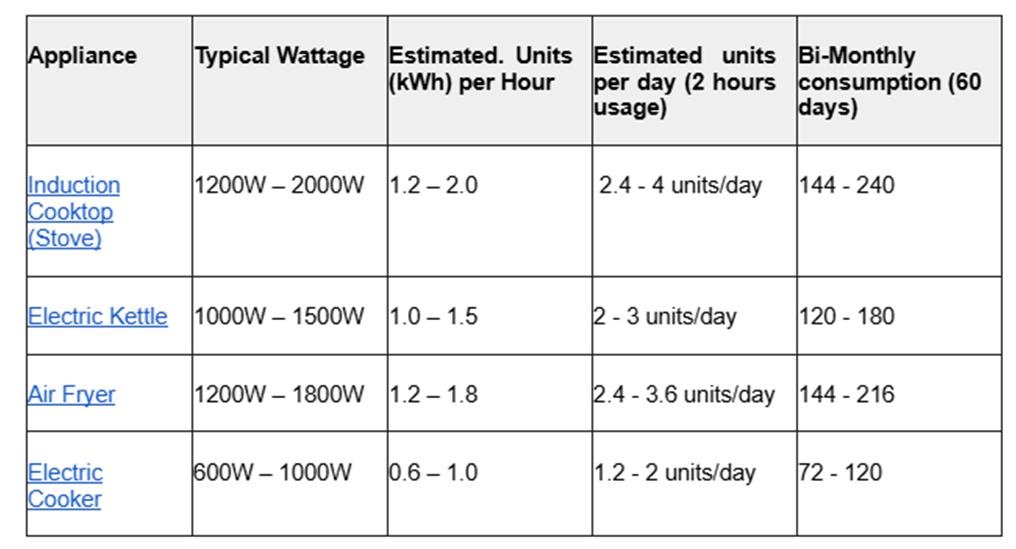
Power consumption of electric cooking appliances
Electric cooking appliances, while high in wattage, typically operate for shorter durations, which moderates their overall energy consumption.
The Emerging Shift: From LPG to Electricity, is it costlier or cheaper?
At a basic level, cooking costs differ between LPG and induction depending on efficiency and electricity tariffs. For example, a 14.2 kg LPG cylinder in Chennai costs about Rs. 928.50 and typically lasts a household for one bi-monthly cycle (two months).
Taking the average of an Induction Cooktop (Stove), if the same household shifts to using a 1500W induction stove for about two hours per day, it would consume roughly 180 units over a bi-monthly period. At an average lower-slab electricity rate, this may appear to cost as little as Rs. 183. Based on this simple comparison, households may perceive a saving of around Rs.745 when switching from LPG to induction cooking
However, this comparison of individual cooking costs alone is misleading and does not reflect real household conditions. A more meaningful assessment requires examining the total household energy budget. This is because cooking electricity is added on top of existing household consumption, such as lighting, fans, televisions, and air conditioning, etc. What matters, therefore, is not just the cost of cooking, but the total household energy budget.
To understand this better, consider a family of four under three different electricity consumption levels: 200 units, 400 units, and 800 units in a bi-monthly cycle.
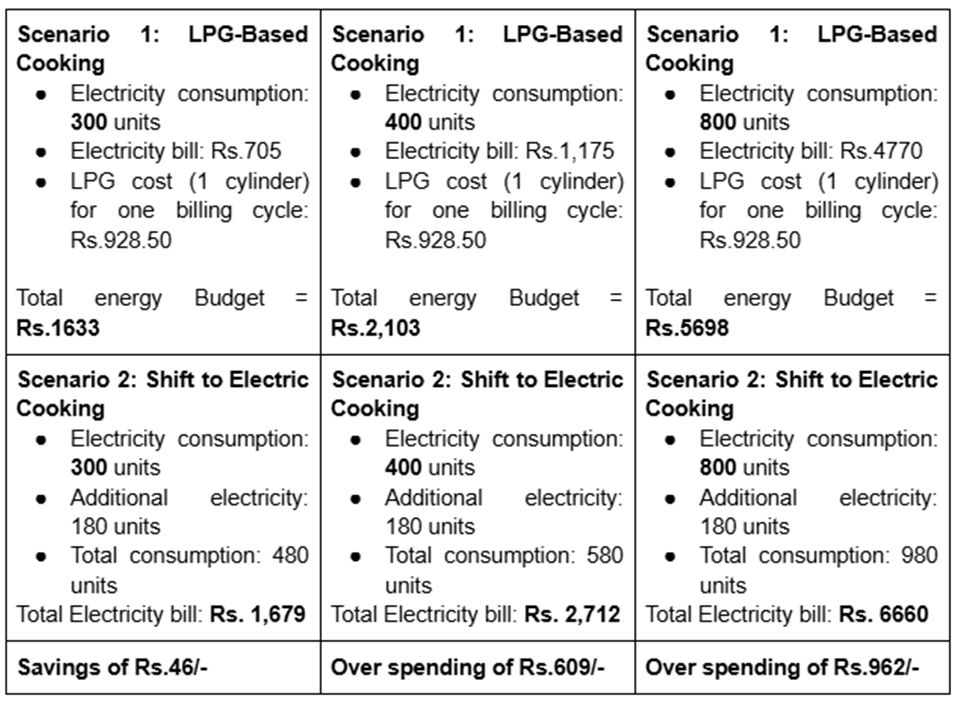
- For a household consuming 300 units, the electricity bill is about Rs.705. Adding LPG (Rs. 928.50), the total energy cost comes to Rs. 1,633. If this household shifts to electric cooking, consumption increases to 480 units, and the electricity bill becomes about Rs. 1,679. In this case, the household actually saves around Rs. 46.
- For a household consuming 400 units, the electricity bill is around Rs. 1,175. With LPG, the total energy cost is Rs. 2,103. After shifting to electric cooking, total consumption rises to 580 units, and the electricity bill increases to about Rs. 2,712. This results in an additional cost of around Rs. 600
- For higher-consuming households using 800 units, the electricity bill is about Rs. 4,770, and the total energy cost with LPG is Rs. 5,698. When they switch to electric cooking, consumption rises to 980 units, and the electricity bill increases to around Rs. 6,660. An increase of nearly Rs. 960, which is roughly equivalent to the cost of one LPG cylinder.
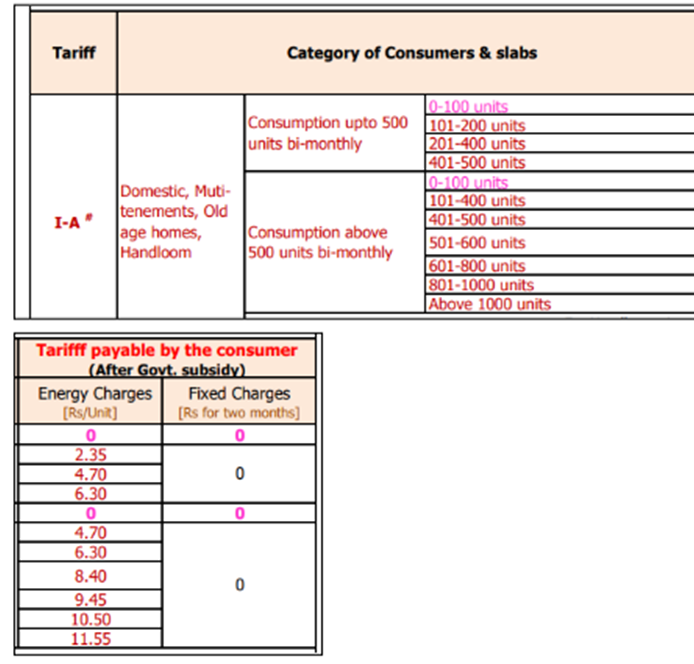
The real reason for their increase in the energy budget is how electricity is priced, not just how much electricity is used. In all three scenarios, the electricity consumption for the induction stove is the same. However, the impact on the total bill differs significantly depending on whether the household crosses a tariff slab. In Tamil Nadu, domestic electricity is billed using a slab-based tariff system, where the price per unit increases as total consumption rises. This means your total bill depends not only on how many units you consume, but also on which slab your consumption falls into.
For example, if a household in Tamil Nadu consumes 490 units, the electricity bill is Rs. 1,742. However, if consumption increases by just 11 units, taking it to 501 units, the total bill can rise sharply to around Rs. 2,048. This is not because those extra 11 units are expensive on their own, but because crossing the 500-unit threshold pushes a larger portion of the total consumption into higher tariff slabs.
As a result, the effective cost per unit increases significantly, and households begin to lose the benefit of lower-cost slabs. The tariff slabs are given below.
This is why many households may feel confused. You may have switched to induction, thinking it is cheaper, and technically, it is, if you look at cooking alone. But when you see your electricity bill, it feels like you are spending more than before. What’s often missed is that LPG costs are no longer part of your expenses, but the electricity bill alone makes the shift feel like an added burden.
So, how can households navigate this transition effectively?
As per the media articles, more people are turning to electric cooking, and it's not just a trend - it is becoming essential due to the unpredictability of energy supplies and the rise of affordable electric appliances. However, to keep electricity bills from getting too high, families should pay attention to how they use these appliances. Making a few simple adjustments in daily habits can lead to significant savings.
- Using induction stoves with flat-bottom, compatible vessels improves heat transfer and reduces cooking time.
- Planning meals in batches, using lids while cooking, and switching off appliances a few minutes before completion (to utilise residual heat) can further cut energy use.
- Appliances like electric kettles and rice cookers should be used purposefully rather than as default options for all tasks.
- Avoiding the simultaneous use of high-wattage devices to reduce the risk of electric shock or the burden of electric circuits.
In the end, small changes in how you use electricity can help you manage your bills better. Keep an eye on your total consumption every billing cycle, especially as you approach the 400–500 unit range. The induction cooking may be cheaper than LPG on its own, but your total household bill depends on how much electricity you use overall. Understanding this can help you make smarter choices and avoid bill shocks.
Add new comment