Introduction: Setting the Context
Distributed Renewable Energy (DRE) has an important role in improving energy access, contributing to climate resilience, and supporting livelihoods, particularly in rural and peri-urban areas. Although Tamil Nadu is known as a leader in renewable energy (renewables comprise approximately 52% of the state’s total installed power capacity), a significant portion of this capacity has been created through large, utility-scale wind and solar projects. Conversely, there has been relatively little deployment of decentralised systems such as rooftop solar or community-scale installations to date, illustrating the need to better understand how current policies and financial mechanisms enable or disable the continued decentralised development of DRE and its associated livelihoods. The study titled "DRE Impact on Livelihoods in the Tamil Nadu Context" assesses how Tamil Nadu's policy, regulatory and financial ecosystem conditions the adoption of DRE, identifying structural barriers to equitable and scalable deployment of DRE. Instead of concentrating on the performance of DRE technology, this study looks at the broader supportive ecosystems in which DRE operates and at the barriers affecting this ecosystem. Five main areas have been identified and used to structure the findings: enabling policy; accessibility/affordability of financial products; the current thriving national market ecosystem; a conducive environment to encourage innovation; and the existence of active entrepreneurial networks that support the advancement and implementation of DRE.
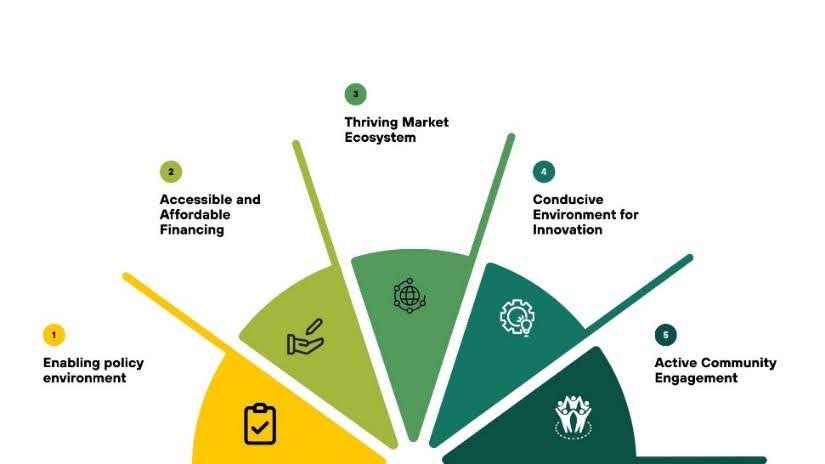
Figure: Core Dimensions of Distributed Renewable Energy
By systematically analysing these dimensions through policy review and expert insights, the study seeks to understand what currently powers DRE growth in Tamil Nadu and where structural gaps persist. Rather than evaluating technologies in isolation, the focus is on the institutional and market conditions that shape the adoption of DRE and its potential to contribute meaningfully to livelihoods and local development.
Methodological Process
The first phase of this research utilised an approach focused on qualitative policy by gathering data through a combination of textual analysis and experts within this field. To initiate the research, the study completed an extensive textual analysis on all DRE-related policies and regulations, both at the state and national level, which included policies like the Tamil Nadu Solar Energy Policy 2019, MNRE Guidelines and the TNERC regulations. The review of these documents identified common dilemmas within the DRE ecosystem, such as inclusivity, finance mechanisms, institutional roles, and community engagement. Based on the findings from the textual analysis, a semi-structured open-ended questionnaire was developed to gather expert opinions regarding Tamil Nadu's DRE ecosystem. Subsequently, expert interviews with various stakeholders (e.g. Public Sector Agencies, financial institutions, NGOs, Research Organisations, community-based organisations) were conducted to gain insight into the DRE ecosystem in Tamil Nadu. The responses received during the qualitative interviews were transcribed and thematically analysed to determine the underlying themes related to policy effectiveness, financial innovation, institutional impediments, and social inclusion.
Key Insights from the Policy and Expert Analysis
The analysis indicated that although Tamil Nadu’s DRE ecosystem is progressive in intent, its impact is constrained by structural and systemic gaps. Fragmented governance and weak coordination between central and state institutions lead to regulatory inconsistencies and implementation delays, creating uncertainty for decentralised investments. Also, financial access remains limited due to low awareness, complex procedures, and the absence of financing models tailored to rural and low-income users. The DRE market ecosystem is further weakened by inconsistent service quality, limited installer accountability, and poor after-sales support, while innovation in storage, hybrid systems, and microgrids is hindered by institutional rigidity. Additionally, limited community participation in planning and implementation reduces local ownership and undermines the long-term sustainability of DRE initiatives.
Why These Findings Matter for Policy
By bridging policy analysis and expert perspectives, the study provides a structured functional understanding of how existing instruments both enable and constrain DRE adoption in Tamil Nadu. The findings point to the need for:
- More integrated DRE governance across agencies and levels of government
- Inclusive financial mechanisms
- Stronger market regulation and quality assurance
- Need for community participation and capacity building
These insights are critical for ensuring that Tamil Nadu’s renewable energy leadership translates into inclusive, decentralised, and livelihood-oriented outcomes, rather than remaining concentrated in large-scale generation.
From Policy Analysis to Community Impact
Despite Tamil Nadu’s progressive renewable energy policies and multiple support schemes, DRE adoption remains uneven across regions and user groups. Rural households, low-income consumers, small enterprises, and community institutions continue to face barriers related to affordability, awareness, institutional coordination, and market reliability.
The study was initiated to respond to three core gaps:
- The policy–practice divide, where well-intended frameworks do not always translate into effective decentralised deployment.
- Limited financial accessibility, particularly for livelihood-linked and community-based DRE applications.
- Weak integration of community participation and institutional coordination in DRE planning and implementation.
Understanding these gaps was essential to assess whether DRE can move beyond individual rooftop installations to become a meaningful livelihood and development enabler.
This first phase of the study establishes the analytical foundation for the next stage of research. The second stage will build on these findings through case studies across sectors, examining how DRE systems interact with livelihoods in agriculture, small enterprises, services, and households. By analysing real-world applications, the next phase will explore how policy and financial gaps identified in the first stage of the study manifest at the community level, and how DRE can contribute to income stability, employment, and resilience when designed and implemented effectively. The complete study will be made available in 2026 upon completion of the second phase of the project.
---
Add new comment