If you think that wearing masks was the mark of safety over the Covid years, think again of residents of metropolitan cities such as Delhi where wearing masks had already been the norm - a practice particularly essential over the winter months when air pollution levels were (are) shockingly high. While the Covid virus was no doubt a killer, Delhi-ites were already familiar with another one — air pollution, silently choking the city long before the pandemic arrived.
Here are some data points that we need to take a minute to spell out and let sink in - in 2021, air pollution was the 2nd largest risk factor of deaths globally. In the same year, the deaths of more than 700,00 children under 5 years were linked to air pollution. This amounted to 15% of all global deaths in this age group. Over 1.67 million premature deaths in India were attributed to air pollution in 2019, which is 25% of the global total of pollution-related fatalities. Of the world’s 30 cities with the worst air pollution, 21 are in India. It doesn’t stop there - every so often, new air pollutants keep getting added to the list. According to a study we are all breathing inhalable microplastics in our very own Singara Chennai. If you are what you eat, how can we ignore what we breathe? When people are exposed to extreme pollution for long periods, it reduces lung capacity and immunity and increases the risk of several fatal diseases. Additionally, it negatively impacts our environment by reducing crop yields, contributing to ozone depletion, disrupting ecosystems, and trapping heat, driving global warming.
Our capital Delhi is one of the most polluted cities in India and the world , with each year the Air Quality Index (AQI) level pushing its citizens into breathing increasingly toxic air. (Delhi’s air pollution is often dangerously high and frequently characterised as “very poor” or “severe.”) The largest contributor to Delhi’s toxic air with a 50 % share is vehicular pollution. The city has 373 vehicles for every 1000 people and although there has been a dip in vehicle numbers (by about 34% from 2015) they still contribute to a big chunk of air pollution. A new study reveals that motor vehicles in Delhi and Gurugram emit far more pollutants than expected. Even retrofitted CNG vehicles were found to emit more nitrogen oxides than expected.
This extreme level of air pollution is reducing every Delhi’ resident’s life expectancy by an average of 11.9 years. The life expectancy of Indians has already decreased from 72 years in 2022 to 70.62 in 2023. And if you live in Delhi, this will be further reduced to 58.72! This is why leading pulmonologists have advised vulnerable residents to leave Delhi in order to protect themselves from Delhi air’s many pollutants including carbon monoxide, nitrogen oxides, particulate matter and volatile organic compounds. These pollutants are toxic to the nervous, respiratory, and cardiovascular systems.
The Delhi administration has taken cognisance of this life threatening issue, and has implemented several measures to reduce air pollution from both vehicular and other sources:
- To combat vehicular emissions during pollution spikes, they implemented a ban on the entry of non-local BS-III and old commercial vehicles.
- They have a ‘Winter Action Plan’, focusing on seven key areas like dust control, vehicular emissions, industrial regulation, waste management, agricultural residue, firecracker control, and citizen participation. Their plan includes deploying mechanical sweepers, sprinklers, and anti-smog guns to curb dust. They are enforcing a strict ban on waste burning and controlling and preventing stubble burning.
- They are enforcing a ban on old and polluting trucks and deploying teams to check for PUC, visible smoke, and idling violations.
- Doubling parking fees to discourage private vehicle use.
- All of these measures will be monitored using a real-time dashboard under the transport department.
- They have also begun to close 411 polluting industries, leaving no room for complacency. The industries violating air pollution norms are sealed immediately without prior notice.
Chennai’s Air Quality
The severity of Delhi’s air crisis highlights a massive challenge in managing urban air quality in Indian cities. While megacities like Delhi have acute pollution issues, cities like Chennai also face high localized risk. The top three highly air polluted areas in Chennai are Alandur, Manali and Perungudi. The AQI index below shows the annual data from 2024-2025 collected by CAG.
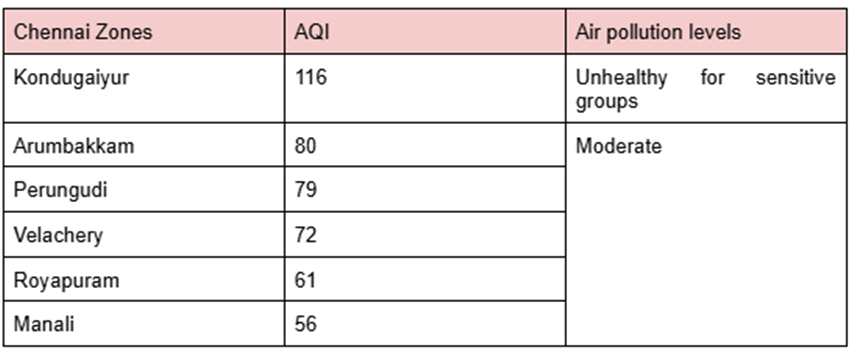
Table 1: AQI index of the most polluted regions in Chennai in 2024-2025. According to data collected by CAG.
Just like in Delhi, in Chennai also, vehicular pollution contributes the most to air pollution with factors like vehicle emissions, traffic congestion, idling and poor fuel quality all playing their part. The consequences of this are particularly borne by groups such as street vendors, traffic police, drivers and delivery agents, who spend many hours outdoors either driving or working by the roadside, breathing in vehicle exhaust.
Given that vehicles are the biggest contributors to air pollution in urban areas, it is important that we focus on promoting sustainable transport, reducing motor vehicle dependency and creating people centric urban plans.
One way of doing this is by promoting Transit Oriented Development (TOD). This is a planning strategy that places homes and workplaces around high-quality public transport like well connected bus stops, train stations, metro stops etc. This makes cities more compact and sustainable.
Building sustainable transport begins with increasing public modal share and reducing private modal share. In Chennai specifically, it is crucial that we increase the size of our bus fleet. Chennai’s bus network connects most key points and neighbourhoods in the city. The letdown though is the number of buses plying between these points. Passengers find themselves forced to take overcrowded buses, or face long waits at bus stops. Each of these is a factor that then pushes them towards private transport when they are able to afford it. CAG together with other partners is part of an initiative called “Double the Bus” asking for more buses in cities. Increasing the fleet size together with improving the first-last mile connectivity keeps commuters on buses, thus reducing congestion and pollution. The anticipated expansion of metro lines will also help make Chennai more sustainable.
Promoting active mobility is another way of ensuring sustainable cities (and healthier people!). Safeguarding walking and cycling by consciously ensuring their safety, particularly through infrastructure such as footpaths and cycling paths encourages people to walk and cycle short distances.
Working with vehicle manufacturers by enhancing emission standards for manufacturers, mandating regular fitness checks for vehicles with clear standards, creating independent inspection centres and where possible, retrofitting programmes for existing vehicles to transition to electric can all be part of clean air measures. We also need to focus on transitioning to zero emission for commercial vehicles with the help of policies, while gradually phasing out highly polluting vehicles from our transport network.
Reducing emissions in the long run can also be achieved by increasing electric vehicle usage for both public and private vehicles. There are already policies in place to gradually transition to EVs. For example, the Tamil Nadu Electric Vehicle Policy 2023 provides generous tax exemptions, mandates charging infrastructures and pushes electric vehicles use throughout the state. However, there remains room for improvement - the state needs to scale EV charging infrastructure in public spaces. Incentives should be offered to establish charging stations not only in public areas but also to support their installation in private locations.
At a city level, creating low-emission zones, and increasing green spaces will improve air quality and public health. Enforcement of our laws is also crucial. Some laws that were created to protect our environment include the Factories Act (1948), Air (Prevention and Control of Pollution) Act 1981 and Environment (Protection) Act 1986. However, these laws remain weakly enforced, often with law breakers not held accountable. These Acts also focus on pollutants like factories, ignoring the many problems wrought by vehicles . Strengthening our legal framework with more appropriate and targeted laws, and then giving more powers to nodal agencies to implement these laws is one way forward.
By taking these steps, policy makers can create reliable and robust public transport while tackling air pollution at the same time. The good news is that Chennai’s Comprehensive Mobility Plan (CMP) has set itself similar goals to achieve over the next 25 years. Achieving a 45% reduction in CO2 emission from transport, increasing public transport mode share, and improving NMT infrastructure are already contained within the Policy.
Vehicular air pollution is no longer an environmental issue; it’s a public health crisis. It’s costing our lives and economy, and it’s demanding immediate and collective action before its impact becomes irreversible. As cities grow, the mobility demand will increase proportionally. The shift to cleaner fuels, a robust public transport network, electric mobility, and effective policy are essential in building healthier and more resilient cities. The path forward requires collective action from governments, industries, and conscious lifestyle changes from citizens. By promoting cleaner alternatives and sustainable mobility, the solution is within reach if we are committed to driving it.
---
Add new comment